

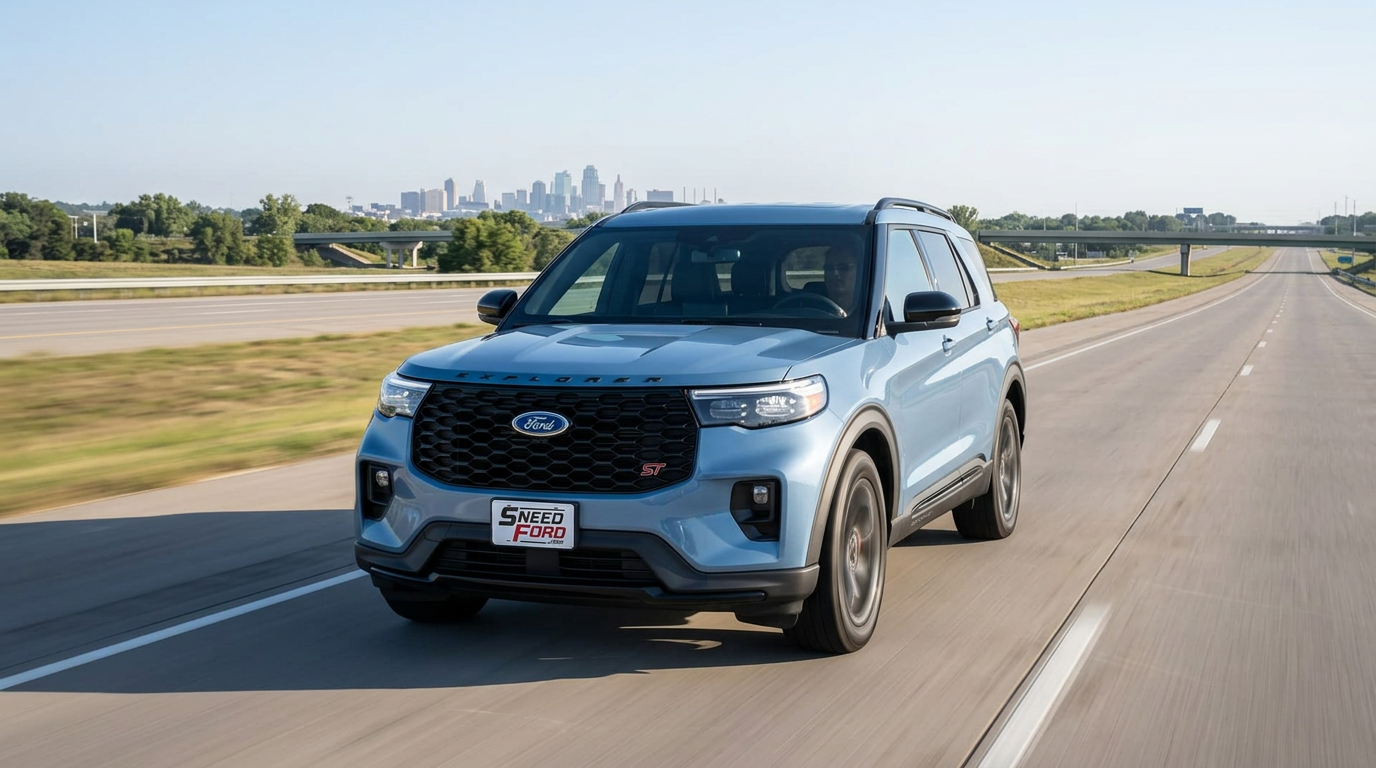
Gas mileage is the number-one question Ford Explorer shoppers ask — and the answer depends entirely on which engine and drivetrain you pick. Here’s the complete, honest breakdown of 2026 Explorer MPG, with real EPA figures verified against Ford window stickers.
How many MPG does the 2026 Ford Explorer get?
Combined — Best Available
2.3L EcoBoost I-4 · rear-wheel drive · 20 city / 29 highway
For a three-row SUV that seats up to seven, that’s a genuinely competitive number. The Explorer’s efficiency comes from the standard 2.3L EcoBoost turbocharged four-cylinder paired with a 10-speed automatic — a combination that delivers enough power for a full family load while keeping highway fuel economy in the high 20s. The trade-off is straightforward: the more power and capability you add (the V6, all-wheel drive, the off-road Tremor), the more the MPG comes down. Below is every configuration, so you can match the number to the Explorer you’re actually considering.
2026 Ford Explorer MPG by engine and drivetrain
| Configuration | City | Highway | Combined |
|---|---|---|---|
| 2.3L EcoBoost — RWD | 20 | 29 | 24 |
| 2.3L EcoBoost — 4WD | 20 | 27 | 23 |
| 3.0L V6 (ST) — RWD | 18 | 25 | 21 |
| 3.0L V6 (ST) — 4WD | 18 | 25 | 20 |
| 3.0L V6 (Tremor) — 4WD | 17 | 22 | 19 |
All figures are EPA estimates, verified against 2026 Ford Explorer window stickers and the official Ford Order Guide. Actual mileage varies with driving conditions, load, and how you drive. Confirm the rating on any specific vehicle via its window sticker.
Is the Ford Explorer good on gas?
The honest way to think about it: no full three-row SUV is a fuel-economy champion, because you’re moving a large, heavy, seven-seat vehicle. But within that class, the 2.3L Explorer is one of the more efficient choices, and the EcoBoost turbo four gives up very little in real-world drivability. If gas mileage is at the top of your list and you don’t need the V6’s towing and passing power, the 2.3L is the clear pick.
What does it cost to fuel a 2026 Explorer per year?
That’s a roughly $350–$450 per year difference between the efficient four-cylinder and the V6 models — useful to weigh against what the V6 gives you in return (385 horsepower, quicker acceleration, and, on the Tremor, real off-road capability). For most family buyers who don’t need the extra power, the 2.3L’s fuel savings add up over years of ownership. For buyers who want the performance or the off-road build, the difference is modest enough that MPG alone shouldn’t be the deciding factor.
Does all-wheel drive lower the Explorer’s MPG?
The city number actually stays the same at 20 MPG; the difference shows up mostly on the highway, where the extra drivetrain weight and parasitic loss matter most. For northwest Missouri winters, most families find the 1–2 MPG trade well worth it — the Explorer’s intelligent 4WD sends power where it’s needed on snow, ice, and gravel, and reverts to efficient rear-wheel drive the rest of the time.
Which 2026 Explorer engine should I choose for fuel economy?
The 2.3L EcoBoost is the right answer for the majority of Explorer buyers. It’s standard on most trims, it delivers the best mileage in the lineup, and it has more than enough power for daily driving, road trips, and the Explorer’s 5,000-lb towing capacity. The 3.0L V6 is a specialty choice — it’s what makes the ST quick and the Tremor capable, and if either of those is what you want, the fuel-economy difference is a fair trade. But if you’re buying an Explorer primarily as an efficient family hauler, the four-cylinder is the smart pick.
For a full head-to-head on both engines — including the honest answer on the V6’s horsepower rating — see our 2026 Explorer engines guide. And for the complete picture on trims, specs, and what’s new, start with the 2026 Ford Explorer buyer’s guide.
30 years family-owned, serving Kansas City and St. Joseph from Gower.
Dennis Sneed Ford is a Top 5 Ford remarketing dealer in the country and a Ford Credit Partners in Quality award winner — one of roughly 111 dealers nationally. We stock the Explorer across trims and drivetrains, so whether you want the efficient 2.3L or the V6 ST, we can put you in the exact configuration that fits your driving. Read why Kansas City families drive to Gower for their Explorer →
Where can I see the 2026 Explorer’s MPG in person near Kansas City?
2026 Ford Explorer MPG questions, answered
How many miles per gallon does the 2026 Ford Explorer get?
The 2026 Ford Explorer gets up to 20 city, 29 highway, and 24 combined MPG with the standard 2.3L EcoBoost four-cylinder in rear-wheel drive. All-wheel-drive 2.3L models get 20/27/23. The 3.0L V6 models range from 18/25/21 on the ST down to 17/22/19 on the Tremor.
Is the Ford Explorer good on gas?
For a three-row midsize SUV, yes. At up to 24 MPG combined and 29 MPG highway, the 2.3L EcoBoost Explorer is competitive with rivals like the Toyota Highlander, Honda Pilot, and Chevy Traverse. No full three-row SUV is a hybrid-level fuel sipper, but within its class the four-cylinder Explorer is one of the more efficient choices.
What is the most fuel-efficient 2026 Explorer?
The 2.3L EcoBoost Explorer in rear-wheel drive is the most fuel-efficient, at 20 city / 29 highway / 24 combined MPG. It comes standard on the Active, ST-Line, and Platinum trims. If maximum fuel economy is your goal, that’s the configuration to choose.
How much does the 2026 Explorer’s V6 affect gas mileage?
The 3.0L EcoBoost V6 lowers combined fuel economy to 20–21 MPG on the ST and 19 MPG on the Tremor, compared to up to 24 MPG for the 2.3L four-cylinder. That’s roughly a 3–5 MPG difference. The V6 trades efficiency for 385 horsepower and, on the Tremor, off-road capability.
Does all-wheel drive lower the Explorer’s fuel economy?
Yes, but only slightly. Adding intelligent 4WD to the 2.3L Explorer drops highway MPG from 29 to 27 and combined from 24 to 23. City mileage stays at 20. The 1–2 MPG penalty is a small trade for the winter traction all-wheel drive provides, which is why it’s popular with Kansas City and northwest Missouri buyers.
What does it cost to fuel a 2026 Ford Explorer per year?
The EPA estimates roughly $2,150 per year for the 2.3L 4WD Explorer, about $2,500 for the V6 ST, and about $2,600 for the V6 Tremor, based on 15,000 miles annually at average fuel prices. These figures come directly from the vehicles’ window stickers and will vary with fuel prices and driving habits.
Does the 2026 Ford Explorer come as a hybrid?
For 2026, the Explorer lineup at Dennis Sneed Ford is offered with the 2.3L EcoBoost four-cylinder and the 3.0L EcoBoost V6, both gas engines. The most fuel-efficient choice is the 2.3L EcoBoost, rated up to 24 MPG combined. Contact us for the latest on Explorer powertrain availability.
Gas mileage is the number-one question Ford Explorer shoppers ask — and the answer depends entirely on which engine and drivetrain you pick. Here’s the complete, honest breakdown of 2026 Explorer MPG, with real EPA figures verified against Ford window stickers.
How many MPG does the 2026 Ford Explorer get?
Combined — Best Available
2.3L EcoBoost I-4 · rear-wheel drive · 20 city / 29 highway
For a three-row SUV that seats up to seven, that’s a genuinely competitive number. The Explorer’s efficiency comes from the standard 2.3L EcoBoost turbocharged four-cylinder paired with a 10-speed automatic — a combination that delivers enough power for a full family load while keeping highway fuel economy in the high 20s. The trade-off is straightforward: the more power and capability you add (the V6, all-wheel drive, the off-road Tremor), the more the MPG comes down. Below is every configuration, so you can match the number to the Explorer you’re actually considering.
2026 Ford Explorer MPG by engine and drivetrain
| Configuration | City | Highway | Combined |
|---|---|---|---|
| 2.3L EcoBoost — RWD | 20 | 29 | 24 |
| 2.3L EcoBoost — 4WD | 20 | 27 | 23 |
| 3.0L V6 (ST) — RWD | 18 | 25 | 21 |
| 3.0L V6 (ST) — 4WD | 18 | 25 | 20 |
| 3.0L V6 (Tremor) — 4WD | 17 | 22 | 19 |
All figures are EPA estimates, verified against 2026 Ford Explorer window stickers and the official Ford Order Guide. Actual mileage varies with driving conditions, load, and how you drive. Confirm the rating on any specific vehicle via its window sticker.
Is the Ford Explorer good on gas?
The honest way to think about it: no full three-row SUV is a fuel-economy champion, because you’re moving a large, heavy, seven-seat vehicle. But within that class, the 2.3L Explorer is one of the more efficient choices, and the EcoBoost turbo four gives up very little in real-world drivability. If gas mileage is at the top of your list and you don’t need the V6’s towing and passing power, the 2.3L is the clear pick.
What does it cost to fuel a 2026 Explorer per year?
That’s a roughly $350–$450 per year difference between the efficient four-cylinder and the V6 models — useful to weigh against what the V6 gives you in return (385 horsepower, quicker acceleration, and, on the Tremor, real off-road capability). For most family buyers who don’t need the extra power, the 2.3L’s fuel savings add up over years of ownership. For buyers who want the performance or the off-road build, the difference is modest enough that MPG alone shouldn’t be the deciding factor.
Does all-wheel drive lower the Explorer’s MPG?
The city number actually stays the same at 20 MPG; the difference shows up mostly on the highway, where the extra drivetrain weight and parasitic loss matter most. For northwest Missouri winters, most families find the 1–2 MPG trade well worth it — the Explorer’s intelligent 4WD sends power where it’s needed on snow, ice, and gravel, and reverts to efficient rear-wheel drive the rest of the time.
Which 2026 Explorer engine should I choose for fuel economy?
The 2.3L EcoBoost is the right answer for the majority of Explorer buyers. It’s standard on most trims, it delivers the best mileage in the lineup, and it has more than enough power for daily driving, road trips, and the Explorer’s 5,000-lb towing capacity. The 3.0L V6 is a specialty choice — it’s what makes the ST quick and the Tremor capable, and if either of those is what you want, the fuel-economy difference is a fair trade. But if you’re buying an Explorer primarily as an efficient family hauler, the four-cylinder is the smart pick.
For a full head-to-head on both engines — including the honest answer on the V6’s horsepower rating — see our 2026 Explorer engines guide. And for the complete picture on trims, specs, and what’s new, start with the 2026 Ford Explorer buyer’s guide.
30 years family-owned, serving Kansas City and St. Joseph from Gower.
Dennis Sneed Ford is a Top 5 Ford remarketing dealer in the country and a Ford Credit Partners in Quality award winner — one of roughly 111 dealers nationally. We stock the Explorer across trims and drivetrains, so whether you want the efficient 2.3L or the V6 ST, we can put you in the exact configuration that fits your driving. Read why Kansas City families drive to Gower for their Explorer →
Where can I see the 2026 Explorer’s MPG in person near Kansas City?
2026 Ford Explorer MPG questions, answered
How many miles per gallon does the 2026 Ford Explorer get?
The 2026 Ford Explorer gets up to 20 city, 29 highway, and 24 combined MPG with the standard 2.3L EcoBoost four-cylinder in rear-wheel drive. All-wheel-drive 2.3L models get 20/27/23. The 3.0L V6 models range from 18/25/21 on the ST down to 17/22/19 on the Tremor.
Is the Ford Explorer good on gas?
For a three-row midsize SUV, yes. At up to 24 MPG combined and 29 MPG highway, the 2.3L EcoBoost Explorer is competitive with rivals like the Toyota Highlander, Honda Pilot, and Chevy Traverse. No full three-row SUV is a hybrid-level fuel sipper, but within its class the four-cylinder Explorer is one of the more efficient choices.
What is the most fuel-efficient 2026 Explorer?
The 2.3L EcoBoost Explorer in rear-wheel drive is the most fuel-efficient, at 20 city / 29 highway / 24 combined MPG. It comes standard on the Active, ST-Line, and Platinum trims. If maximum fuel economy is your goal, that’s the configuration to choose.
How much does the 2026 Explorer’s V6 affect gas mileage?
The 3.0L EcoBoost V6 lowers combined fuel economy to 20–21 MPG on the ST and 19 MPG on the Tremor, compared to up to 24 MPG for the 2.3L four-cylinder. That’s roughly a 3–5 MPG difference. The V6 trades efficiency for 385 horsepower and, on the Tremor, off-road capability.
Does all-wheel drive lower the Explorer’s fuel economy?
Yes, but only slightly. Adding intelligent 4WD to the 2.3L Explorer drops highway MPG from 29 to 27 and combined from 24 to 23. City mileage stays at 20. The 1–2 MPG penalty is a small trade for the winter traction all-wheel drive provides, which is why it’s popular with Kansas City and northwest Missouri buyers.
What does it cost to fuel a 2026 Ford Explorer per year?
The EPA estimates roughly $2,150 per year for the 2.3L 4WD Explorer, about $2,500 for the V6 ST, and about $2,600 for the V6 Tremor, based on 15,000 miles annually at average fuel prices. These figures come directly from the vehicles’ window stickers and will vary with fuel prices and driving habits.
Does the 2026 Ford Explorer come as a hybrid?
For 2026, the Explorer lineup at Dennis Sneed Ford is offered with the 2.3L EcoBoost four-cylinder and the 3.0L EcoBoost V6, both gas engines. The most fuel-efficient choice is the 2.3L EcoBoost, rated up to 24 MPG combined. Contact us for the latest on Explorer powertrain availability.
Connect with us


- 2025 Ford Bronco Sport Big Bend
- 2025 Ford Bronco Sport Outer Banks
- Battery Maintenance
- chevy silverado
- Dennis Sneed Ford
- Dennis Sneed Ford Service
- Ford Bronco Sport
- Ford Explorer
- Ford F-150
- Ford Super Duty
- Ford Super Duty Trucks
- Ford SUVs
- Ford Trucks
- Gower Ford Dealer
- Gower Ford Service
- Gower Used Cars
- How Long Does a Car Battery Last
- How To Change Your Oil
- Uncategorized
- Used Ford Trucks