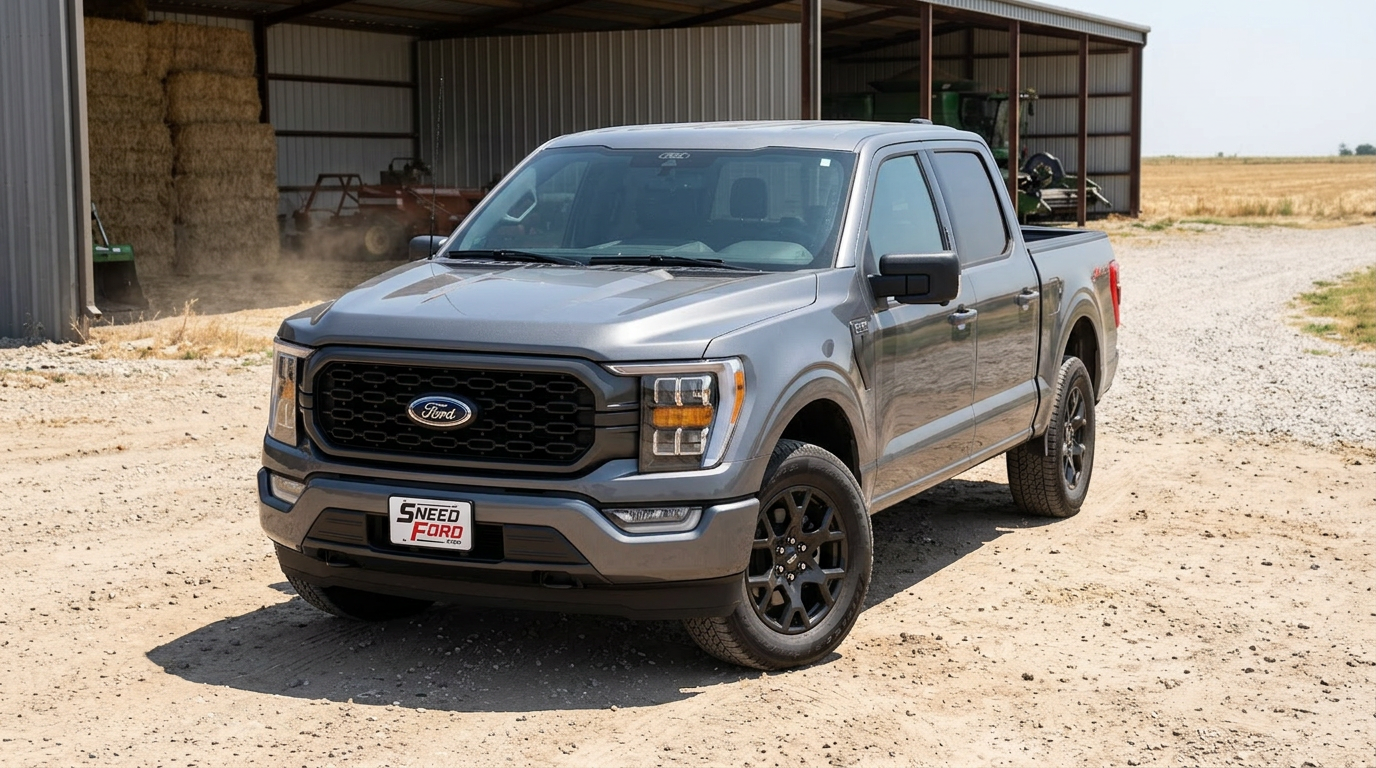
Ford gives you six engines in the 2026 F-150 — from a 325-hp twin-turbo V6 to a 720-hp supercharged V8. The differences in fuel economy, towing, and real-world feel are bigger than most buyers realize. Here’s how to figure out which engine is actually right for you.
How many engines does the 2026 Ford F-150 come with?
For most buyers, four of those six engines are realistic choices — the 2.7L EcoBoost, the 5.0L V8, the 3.5L EcoBoost, and the PowerBoost Hybrid. The two Raptor engines are trim-locked to the Raptor and Raptor R, so they’re only on the table if you’re shopping that specific truck.
All 6 2026 F-150 engines, explained
2.7L EcoBoost V6
The F-150’s best-kept secret. A twin-turbo V6 that’s lighter than the 3.5L, gets noticeably better fuel economy unloaded, and still handles most consumer trailers and boats up to 8,400 lbs without breaking a sweat. Standard on XL (141″/145″ wheelbase), STX, and XLT.
Best for: daily-driver buyers who tow occasionally under 5,000 lbs and want the best fuel economy in a non-hybrid F-150.
5.0L Ti-VCT V8
The naturally aspirated V8 for buyers who want the sound, the feel, and the linear power delivery of a traditional V8. Strong second-place tow capability at 12,800 lbs. Standard on XL with 122″ wheelbase, optional throughout most of the lineup.
Best for: buyers who specifically want a V8, prefer naturally aspirated character, and tow up to 12,000 lbs regularly.
3.5L EcoBoost V6
The headline engine. 500 lb-ft of torque (the most of any non-Raptor F-150 engine), the full 13,500-lb max tow rating, and 2,440 lbs of max payload. Standard on Lariat, King Ranch, Platinum, and Tremor. The right answer for most buyers who tow.
Best for: regular towing over 5,000 lbs, anyone wanting maximum capability, and the engine that makes the F-150 class-leading.
3.5L PowerBoost Full Hybrid V6
The hybrid F-150. SAE-rated 420 hp and 570 lb-ft of total-system output. Best fuel economy in any F-150 by a meaningful margin (22 mpg city). Standard 2.4 kW Pro Power Onboard, with available 7.2 kW Pro Power Onboard — enough to run a window AC, microwave, lights, and a TV simultaneously, or back up the essentials in a power outage. New for 2026: now available with 4×2 on STX, XLT, Lariat, King Ranch, and Platinum from Job 2 production onward.
Best for: buyers who camp, tailgate, or work off-grid and want serious onboard power; or anyone wanting the highest F-150 fuel economy.
3.5L HO EcoBoost V6 (Raptor)
The High-Output version of the 3.5L EcoBoost, tuned for the Raptor’s off-road performance mission. 450 hp delivered through the long-travel suspension and 4×4 with Hi-Lock transfer case. Tow rating drops compared to the standard 3.5L EcoBoost because the truck is configured for off-road, not max-tow, duty.
Best for: Raptor buyers. Trim-locked — you can’t get this engine in any other F-150 trim.
5.2L Supercharged V8 (Raptor R)
The 5.2L supercharged V8 from the Mustang Shelby GT500, dropped into the F-150 Raptor R. 720 hp, 640 lb-ft, and zero practical purpose other than going extremely fast through the desert. Available exclusively on the Raptor R sub-model.
Best for: Raptor R buyers. A niche-within-a-niche — pure performance toy.
*PowerBoost figures are SAE-rated total-system output. All capability numbers shown are maximum when properly configured.
2026 F-150 engine comparison at a glance
| Engine | HP | Torque | Max Tow | Max Payload | MPG (4×2) |
|---|---|---|---|---|---|
| 2.7L EcoBoost V6 | 325 | 400 lb-ft | 8,400 lbs | 1,775 lbs | 19/25 |
| 5.0L Ti-VCT V8 | 400 | 410 lb-ft | 12,800 lbs | 2,235 lbs | 16/24 |
| 3.5L EcoBoost V6 | 400 | 500 lb-ft | 13,500 lbs | 2,440 lbs | 17/25 |
| 3.5L PowerBoost Hybrid | 420* | 570 lb-ft* | up to 11,600 lbs | up to 2,045 lbs | 22/24 |
| 3.5L HO EcoBoost (Raptor) | 450 | 510 lb-ft | 8,200 lbs | 1,400 lbs | 14/18 |
| 5.2L SC V8 (Raptor R) | 720 | 640 lb-ft | 8,700 lbs | 1,400 lbs | 10/15 |
The 2026 F-150 engine matchups buyers actually cross-shop
Most F-150 buyers don’t sit there comparing all six engines at once — they get stuck between two specific options. Here are the matchups we walk customers through most often at Sneed Ford.
2.7L EcoBoost vs 3.5L EcoBoost
The most common F-150 engine cross-shop. Both are twin-turbo V6s with very similar fuel economy on paper. The 3.5L produces 75 more hp, 100 more lb-ft of torque, and tows 5,100 more pounds when properly configured. The 2.7L is lighter, costs less, and feels noticeably more responsive in unloaded daily driving.
If you tow regularly over 5,000 lbs, the 3.5L EcoBoost is the right answer. If your towing is occasional and under 5,000 lbs, the 2.7L is genuinely a better daily driver and saves real money up front.
5.0L V8 vs 3.5L EcoBoost
The traditional vs modern matchup. Same horsepower (400), but the 3.5L EcoBoost makes 90 more lb-ft of torque (500 vs 410) at much lower rpm (3,100 vs 4,250) and tows 700 more pounds. The 5.0L V8 trades that capability for the V8 sound, the linear power delivery, and the naturally aspirated character that some buyers will never give up.
Spec sheet says 3.5L EcoBoost. Heart says 5.0L V8. Both are completely defensible choices — this is more of a personal preference call than a performance one.
3.5L EcoBoost vs PowerBoost Hybrid
The capability vs hybrid matchup. The 3.5L EcoBoost tows more (13,500 vs ~11,600 lbs) and carries more payload (2,440 vs 2,045 lbs). The PowerBoost gets dramatically better fuel economy (22/24 mpg vs 17/25), produces more torque on paper (570 vs 500 lb-ft), and adds the option of 7.2 kW Pro Power Onboard — which the gas EcoBoost cannot match.
If maximum tow is the priority, gas 3.5L EcoBoost. If you camp, tailgate, work off-grid, want the best F-150 fuel economy, or value the onboard power feature, PowerBoost Hybrid.
What’s the most fuel-efficient 2026 F-150 engine?
The PowerBoost Hybrid’s fuel economy advantage is most visible in city driving and stop-and-go, where the hybrid system can shut off the gas engine entirely at low speeds. On long highway runs it’s closer to the 3.5L EcoBoost — both are doing about 24-25 mpg. But over a year of mixed driving, the hybrid will save real fuel.
Which 2026 F-150 engine is best for towing?
Hitting the 13,500-lb max tow rating requires more than just the right engine — it also requires the Tow/Haul Package, the Max Tow electronic-locking rear axle, and the right cab and bed combination. For the complete configuration walkthrough, read our complete 2026 F-150 towing guide.
Which 2026 F-150 engine should you get?
Click the use case that fits you best for our recommendation.
I tow regularly over 5,000 lbs and want maximum capability
The 3.5L EcoBoost V6. 400 hp, 500 lb-ft of torque, the F-150’s full 13,500-lb max tow rating, and 2,440 lbs of max payload. Pair it with the Tow/Haul Package and the Max Tow electronic-locking rear axle (3.55 XL5 or 3.73 XL7) to unlock the full rating. Standard on Lariat, King Ranch, Platinum, and Tremor.
I daily drive my F-150 and rarely tow more than a small boat or trailer
The 2.7L EcoBoost V6. 325 hp, 400 lb-ft of torque, and 8,400-lb max tow handles most consumer trailers and boats. Better fuel economy than the 3.5L when unloaded, lighter, and noticeably more responsive in daily driving. Standard on XL, STX, and XLT — the most common F-150 engine for buyers who don’t tow regularly.
I want a V8 specifically — sound, feel, naturally aspirated character
The 5.0L Ti-VCT V8. 400 hp, 410 lb-ft of torque, 12,800-lb max tow. This is the engine for buyers who specifically want a V8 and would rather give up some peak torque than drive a turbo V6. Strong second-place tow capability behind the 3.5L EcoBoost.
I camp, tailgate, work off-grid, or want serious onboard power
The 3.5L PowerBoost Full Hybrid V6. The available 7.2 kW Pro Power Onboard turns the truck into a mobile generator — enough to run a window AC, microwave, lights, and TV simultaneously, or back up the essentials in a power outage. 420 hp / 570 lb-ft SAE-rated total-system output, up to 11,600 lbs max tow, and the best F-150 fuel economy (22/24 mpg on the 4×4).
Fuel economy is my top priority
The 3.5L PowerBoost Hybrid at 22 mpg city / 24 mpg highway. The gap over the next-best gas engine (the 2.7L EcoBoost at 19/25 in 4×2) is meaningful in real-world driving, especially in city and stop-and-go conditions where the hybrid system shines.
If hybrid is not on the table, the 2.7L EcoBoost in 4×2 is the next-best fuel-economy option at 19/25 mpg.
I want serious off-road performance, not maximum tow
The 3.5L HO EcoBoost V6 in the F-150 Raptor. 450 hp, 510 lb-ft, paired with the Raptor’s long-travel suspension, available 37″ tires, and Baja terrain mode. Tow rating is lower (8,200 lbs) because the truck is built for going fast off-road, not pulling heavy.
I want the most powerful F-150 ever built and money is not a constraint
The 5.2L Supercharged V8 in the F-150 Raptor R. 720 hp, 640 lb-ft — the same engine that powered the Mustang Shelby GT500, now in a four-door truck with long-travel suspension. Fuel economy is 10/15 mpg. Practical purpose: none. Thrill: maximum.
30 years of helping buyers pick the right engine — not the most expensive one.
Dennis Sneed Ford is a Ford Credit Partners in Quality award winner (one of approximately 111 dealers nationally) and one of the Top 5 Ford remarketing dealers in the country. We see thousands of off-lease F-150s come through our remarketing program every year — which means we know which engine choices age well, which deliver the real-world fuel economy buyers actually see, and which configurations buyers come back and trade in early. We’ll spec the engine that fits how you actually use the truck. Read why Kansas City F-150 buyers drive 45 minutes to Gower →
2026 F-150 engine questions, answered
How many engines does the 2026 Ford F-150 come with?
Six. The 2.7L EcoBoost V6, the 5.0L Ti-VCT V8, the 3.5L EcoBoost V6, the 3.5L PowerBoost Full Hybrid V6, the 3.5L HO EcoBoost V6 (exclusive to the Raptor), and the 5.2L Supercharged V8 (exclusive to the Raptor R). All six pair with a 10-speed automatic transmission.
What is the best 2026 F-150 engine for towing?
The 3.5L EcoBoost V6, by a clear margin. With the Tow/Haul Package and Max Tow electronic-locking rear axle, it delivers the F-150’s full 13,500-lb max tow rating and 2,440 lbs of max payload. The 5.0L V8 follows at 12,800 lbs and the PowerBoost Hybrid handles up to 11,600 lbs.
What is the most fuel-efficient 2026 F-150 engine?
The 3.5L PowerBoost Full Hybrid V6, at 22 mpg city and 24 mpg highway on the 4×4. The PowerBoost is the only hybrid F-150 engine and offers the best fuel economy in the lineup by a meaningful margin, especially in city and stop-and-go driving.
What is the difference between the 2.7L EcoBoost and the 3.5L EcoBoost?
Both are twin-turbo V6s with similar fuel economy. The 3.5L EcoBoost produces 400 hp and 500 lb-ft of torque with a 13,500-lb max tow rating. The 2.7L EcoBoost produces 325 hp and 400 lb-ft with an 8,400-lb max tow rating. The 2.7L is lighter, more responsive in unloaded driving, and costs less. The 3.5L is the answer if you tow regularly over 5,000 lbs.
How many horsepower does the 2026 F-150 PowerBoost Hybrid have?
420 horsepower and 570 lb-ft of torque as SAE-rated total-system output. The PowerBoost Hybrid combines the 3.5L EcoBoost V6 with an electric motor and lithium-ion battery, and also offers Pro Power Onboard up to 7.2 kW — enough to run a window AC, microwave, lights, and TV simultaneously, or back up the essentials in a power outage.
Does the 2026 F-150 still come with the 5.0L V8?
Yes. The naturally aspirated 5.0L Ti-VCT V8 remains available on most F-150 trims for 2026, producing 400 hp and 410 lb-ft of torque. It is standard on the XL with the 122″ wheelbase and optional throughout most of the lineup. Max tow is 12,800 lbs when properly configured.
Which 2026 F-150 engine is in the Raptor R?
The Raptor R uses the 5.2L Supercharged V8 producing 720 horsepower and 640 lb-ft of torque — the same engine that powered the Mustang Shelby GT500. It is exclusive to the Raptor R sub-model and is not available in any other F-150 trim.
What transmission do 2026 F-150 engines use?
All 2026 F-150 engines pair with a 10-speed automatic transmission. The PowerBoost Hybrid uses a hybrid version of the 10-speed that incorporates the electric motor. All gas engines use the standard 10-speed.