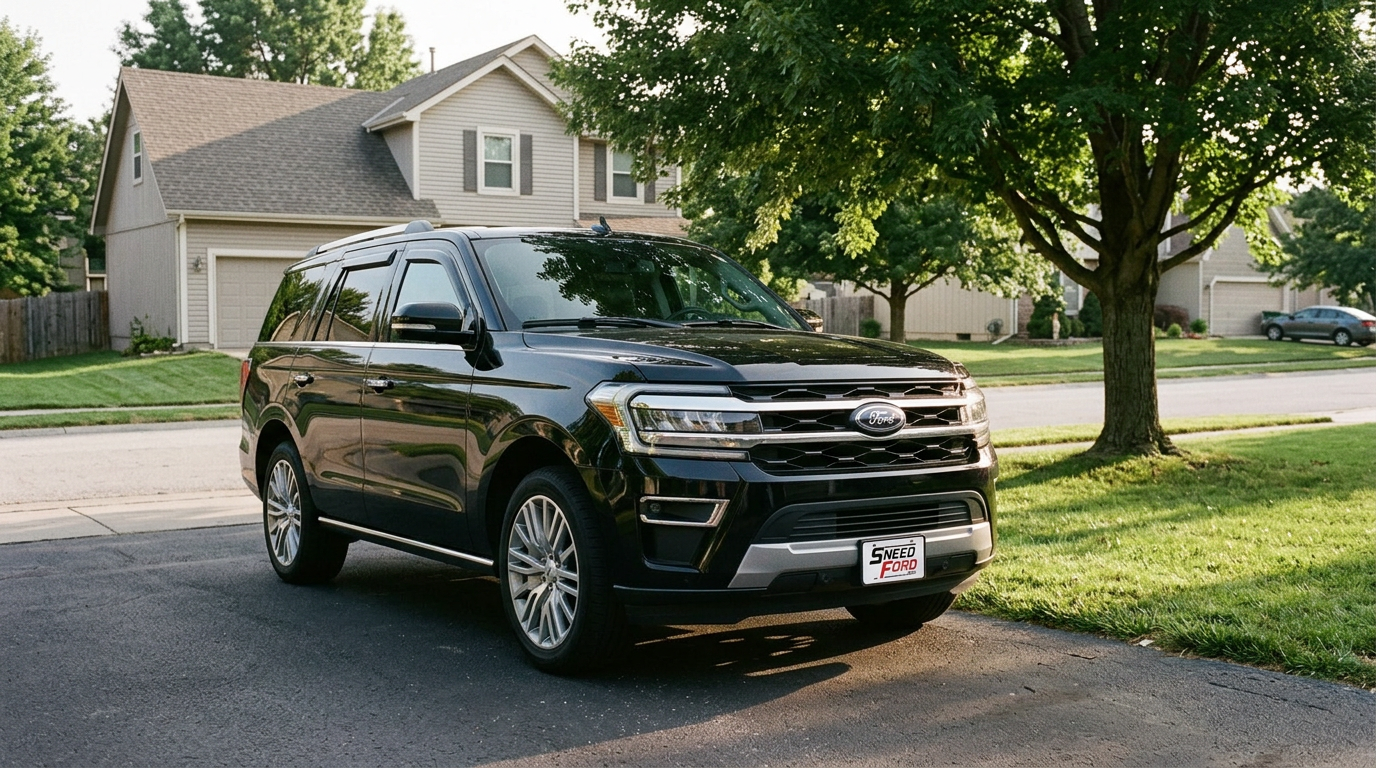

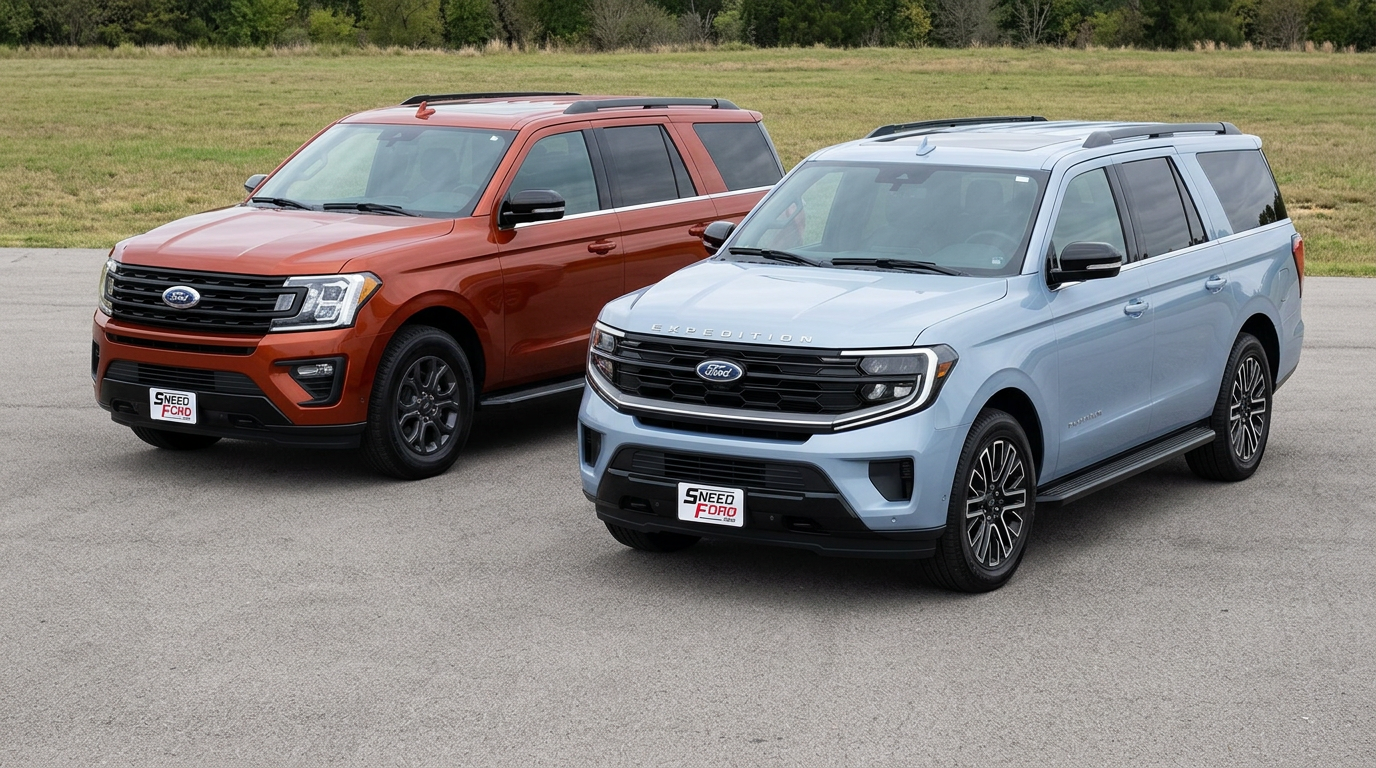
The Ford Expedition comes in two lengths, and the longer one is not simply more of the same vehicle. The Expedition MAX is 11.8 inches longer than the standard Expedition, and almost all of that goes into cargo space behind the third row, where it adds more than half again as much room. But it also changes what the vehicle can pull, and not in the direction most people assume. Here is exactly what the MAX gains, what it gives up, and which one to order.
Quick answer: The 2027 Expedition MAX is 221.7 inches long against the standard Expedition's 209.9 inches. It carries 37.4 cubic feet behind the third row versus 22.9, an increase of 14.5 cubic feet. Both are the same width. In four-wheel drive the standard Expedition tows more, 9,600 lbs against the MAX's 9,000. In two-wheel drive the MAX tows more, 6,300 lbs against 6,000. The Tremor is not offered in the MAX body.
How much longer is the Expedition MAX?
The Expedition MAX is 221.7 inches long and the standard Expedition is 209.9 inches, a difference of 11.8 inches. That is a little under a foot on a vehicle that is already more than seventeen feet long, so it is roughly a 6 percent increase in overall length.
Expedition · 209.9 in
Expedition MAX · 221.7 in
Bars shown to scale. The added length sits behind the rear door, which is why it turns into cargo volume rather than legroom.
The width is identical. Both measure 94.6 inches including mirrors, so the MAX is no harder to keep inside a lane, no harder to thread through a drive-through, and no wider in a garage. Everything the extra size costs you is length, which matters in parallel parking and in a garage with a workbench at the far end, and nowhere else.
2027 Expedition vs Expedition MAX: the full comparison
| Measure | Expedition | Expedition MAX | Difference |
|---|---|---|---|
| Length | 209.9 in | 221.7 in | MAX +11.8 in |
| Width including mirrors | 94.6 in | 94.6 in | Same |
| Cargo behind third row | 22.9 cu ft | 37.4 cu ft | MAX +14.5 cu ft |
| Cargo behind second row | 69.9 cu ft | 84.5 cu ft | MAX +14.6 cu ft |
| Maximum cargo | 108.5 cu ft | 123.1 cu ft | MAX +14.6 cu ft |
| Towing, 4x4 with Heavy-Duty Trailer Tow | 9,600 lbs | 9,000 lbs | MAX −600 lbs |
| Towing, 4x2 | 6,000 lbs | 6,300 lbs | MAX +300 lbs |
| Engines offered | Same: 3.5L EcoBoost V6, High-Output available on Platinum | Same | |
| EPA-estimated MPG | Same: 16/23 in 4x2, 15/22 in 4x4 | Same | |
| Tremor offered | Yes | No | Standard wheelbase only |
What the Expedition MAX actually gains you
Cargo space behind the third row, and that is the measurement that matters. The MAX carries 37.4 cubic feet back there against the standard Expedition's 22.9, an increase of roughly 63 percent. Behind the second row and with everything folded the gain is about the same in absolute terms, around 14.5 cubic feet.
Here is why that one number decides the question for most families. With all three rows up, the standard Expedition's 22.9 cubic feet is roughly a large-SUV trunk. It handles a grocery run and a couple of duffel bags. It does not comfortably handle luggage for seven people, which is exactly the situation you bought a three-row SUV to be in.
The MAX's 37.4 cubic feet changes that. It is the difference between folding a seat down on a road trip and not having to.
Notice also that the gain is nearly identical at every seat position, about 14.5 cubic feet whether the seats are up or down. The MAX is not a bigger box everywhere. It is the same vehicle with a longer tail.
Does the Expedition MAX tow less?
In four-wheel drive, yes. A four-wheel-drive Expedition with the Heavy-Duty Trailer Tow Package is rated at 9,600 lbs, while the same setup on a MAX is rated at 9,000 lbs. In two-wheel drive it reverses: the MAX is rated at 6,300 lbs against the standard Expedition's 6,000.
This is the detail almost everyone gets wrong. It is not true that the MAX simply tows less. In two-wheel drive the MAX tows 300 lbs more. The 600-lb penalty applies only in four-wheel drive, which happens to be the configuration anyone serious about towing is ordering, because the Heavy-Duty Trailer Tow Package is offered on four-wheel-drive models.
| Drivetrain | Expedition | Expedition MAX |
|---|---|---|
| 4x2 | 6,000 lbs | 6,300 lbs |
| 4x4 with Heavy-Duty Trailer Tow Package | 9,600 lbs | 9,000 lbs |
So the practical rule is simple. If you tow near the top of the range, order a four-wheel-drive standard-wheelbase Expedition and you get the highest rating in the lineup. If you are towing something modest and want the cargo room, the MAX costs you nothing you will notice. Ford's towing guide also calls for a weight-distributing hitch on trailer ratings above 7,000 lbs on both bodies.
What stays the same between them
More than you might expect, which is why this decision comes down to cargo versus tow rating rather than to a long list of tradeoffs.
- Width. Both are 94.6 inches including mirrors.
- Engines. Both use the 3.5L EcoBoost V6 at 400 horsepower and 480 lb-ft, with the 440-horsepower High-Output version available on Platinum and MAX Platinum. Both pair with a 10-speed automatic.
- Fuel economy. Ford publishes the same EPA estimates for both: 16 mpg city and 23 mpg highway in two-wheel drive, 15 and 22 in four-wheel drive.
- Seating. Each trim carries the same standard and available seating in either length. Active and MAX Active are eight standard, Platinum and MAX Platinum are seven standard with eight available, and King Ranch and MAX King Ranch are seven only.
- Colors. Color availability follows the trim, not the body length.
The one combination you cannot order
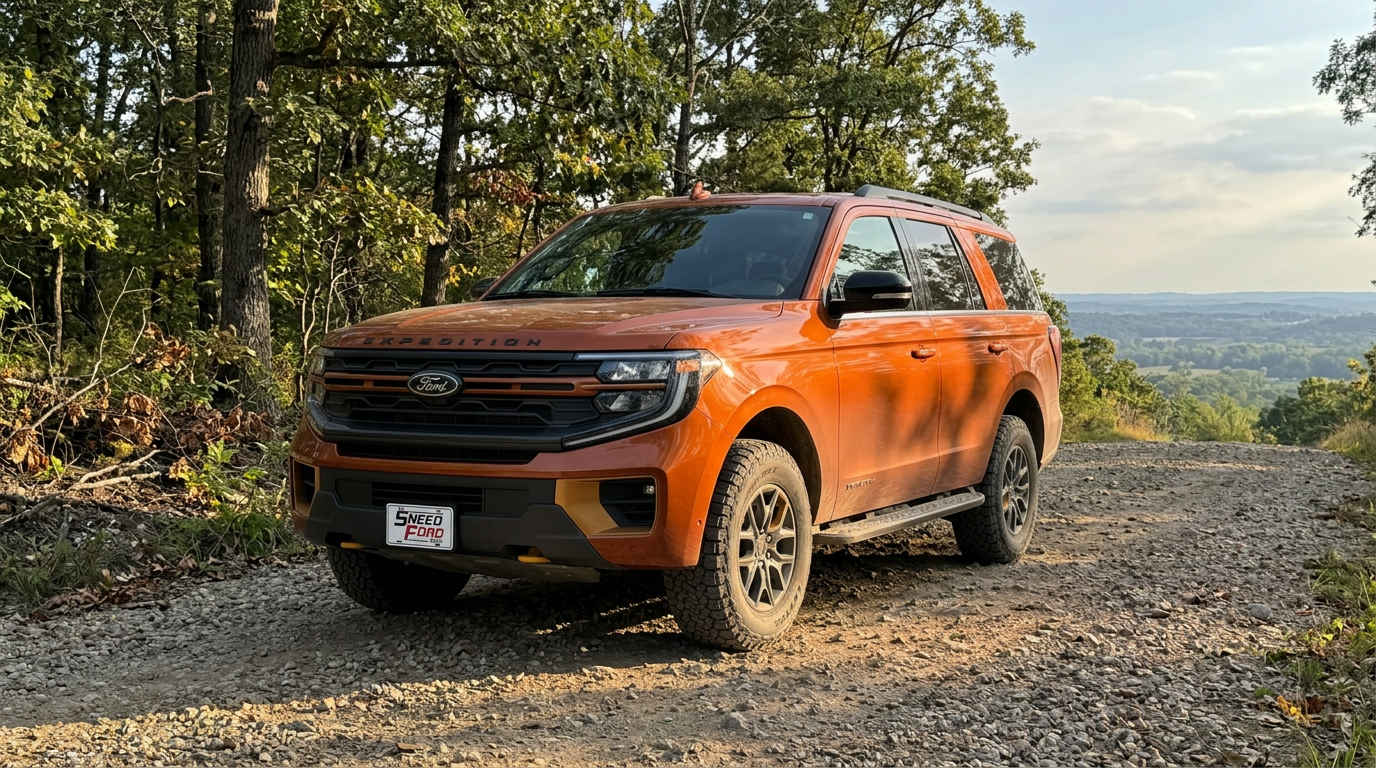
There is no Expedition MAX Tremor. The Tremor is offered in the standard wheelbase only, which means the raised ride height and 10.6 inches of minimum running ground clearance cannot be combined with the MAX body and its larger cargo area.
If you want Tremor capability, you are taking the shorter vehicle and the smaller cargo hold. If you want MAX cargo space, you are taking 8.7 inches of ground clearance like every other Expedition. There is no version that does both, and it is worth knowing before you start building one rather than after. Our 2027 Expedition trims guide covers the rest of the configuration decisions.
Should you buy the Expedition or the Expedition MAX?
Three questions settle it.
- Do you regularly travel with the third row occupied? If yes, the MAX. The 22.9 cubic feet behind the standard Expedition's third row fills up faster than people expect, and 37.4 is the number that makes a full vehicle practical.
- Do you tow near 9,000 lbs or more? If yes, the standard wheelbase in four-wheel drive. It is rated at 9,600 lbs, the highest in the lineup.
- Do you need Tremor's ground clearance? If yes, the decision is already made. Standard wheelbase is the only option.
For most families who bought a full-size SUV because they genuinely needed three usable rows, the MAX is the right answer and the tow difference never comes up. For the buyer pulling a heavy travel trailer or a loaded boat, the standard wheelbase in four-wheel drive is worth the smaller cargo hold.
See both lengths side by side near Kansas City
Dennis Sneed Ford is at 1046 S.W. Highway 169 in Gower, MO, about 45 minutes north of the Kansas City metro and roughly 30 minutes south of St. Joseph on US-169. Eleven inches is hard to picture from a spec sheet and obvious when the two are parked next to each other, which is the fastest way to settle this.
Call 816-409-1975 to find out whether we have both lengths on the ground, or to factory-order the one you want. For the full vehicle breakdown read our 2027 Ford Expedition buyer's guide, or start with the complete Ford Expedition research guide.
Expedition vs Expedition MAX questions, answered
How much longer is the Ford Expedition MAX?
The 2027 Ford Expedition MAX is 221.7 inches long and the standard Expedition is 209.9 inches, a difference of 11.8 inches. Both are 94.6 inches wide including mirrors, so the MAX is longer but not wider. The additional length sits behind the rear door and goes into cargo volume.
How much more cargo space does the Expedition MAX have?
The Expedition MAX offers 37.4 cubic feet behind the third row against 22.9 for the standard Expedition, an increase of 14.5 cubic feet or roughly 63 percent. Behind the second row it offers 84.5 cubic feet against 69.9, and with all rear seats folded it offers 123.1 cubic feet against 108.5. These are Ford's available optimized cargo volumes.
Does the Ford Expedition MAX tow less than the regular Expedition?
It depends on drivetrain. In four-wheel drive with the Heavy-Duty Trailer Tow Package the standard Expedition is rated at up to 9,600 lbs and the MAX at up to 9,000 lbs, so the MAX tows 600 lbs less. In two-wheel drive the MAX is rated at up to 6,300 lbs and the standard Expedition at up to 6,000 lbs, so the MAX tows 300 lbs more. The Heavy-Duty Trailer Tow Package is offered on four-wheel-drive models.
Is there an Expedition MAX Tremor?
No. The Expedition Tremor is offered in the standard wheelbase only. The 2027 Expedition MAX is available as MAX Active, MAX Platinum, and MAX King Ranch. Tremor's raised ride height and 10.6 inches of minimum running ground clearance cannot be combined with the longer MAX body.
Do the Expedition and Expedition MAX get the same gas mileage?
Ford publishes the same EPA estimates for both. Two-wheel-drive models are EPA-estimated at 16 mpg city and 23 mpg highway, and four-wheel-drive models at 15 mpg city and 22 mpg highway. Ford does not publish a combined figure for the 2027 Expedition.
Is the Expedition MAX harder to park?
It is 11.8 inches longer, which matters when parallel parking or fitting into a shorter garage, but it is exactly as wide as the standard Expedition at 94.6 inches including mirrors. Lane position, drive-throughs, and garage width are unaffected. Length is the only dimension that changes.
Although every reasonable effort has been made to ensure accuracy, absolute accuracy cannot be guaranteed. Specifications verified against Ford's published 2027 Expedition specifications and Ford's published 2027 Expedition towing guide. Cargo volumes are Ford's available optimized figures. Towing figures require proper equipment and vary based on cargo, configuration, accessories, and number of passengers. EPA-estimated ratings are for comparison purposes only; actual mileage varies. Feature, model, and package availability changes through the model year. Confirm the exact equipment on any specific vehicle via its window sticker.